Ecuador continues cooperation with Haiti in military training
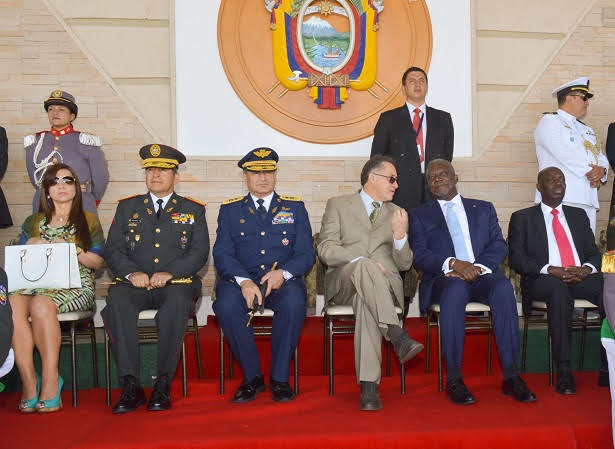
L he Minister of Defense, Ambassador Hervé Denis, accompanied by his Director General, Colonel Louis Marcelin Daniel, stayed in Ecuador during the week of 15 August 2017, on the occasion of the graduation of Haitian engineer soldiers. These soldiers, trained at the Soldier Training School of the Land Force of Ecuador, constitute the 5th class of soldiers graduated since 2012 as part of the creation of a new national defense force.
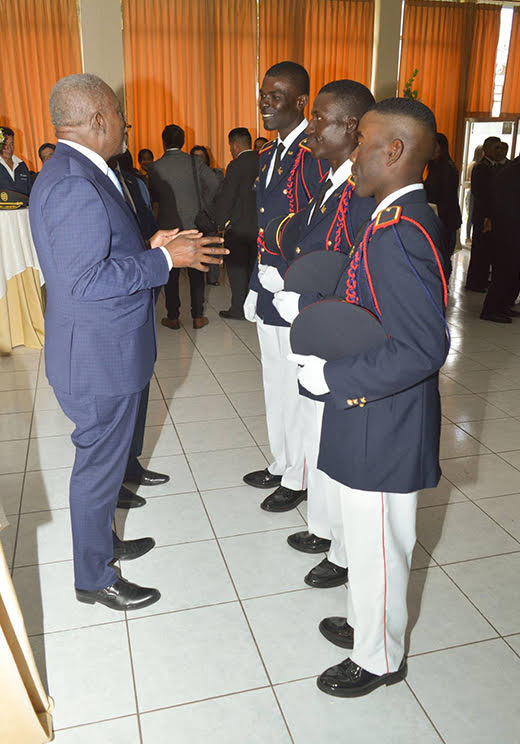
At the end of the ceremony, a working meeting took place between the holder of the Ministry of Defense and his Ecuadorian counterpart, Mr. Miguel Cavajal as well as members of the Staff of the Ecuadorian army where Mr. Denis made a presentation of the vision of the Haitian government of the new defense force as well as the steps in progress for its creation. This meeting was also an opportunity for the two parties to review the results obtained within the framework of the Cooperation Agreement signed on September 21, 2012, on the one hand and on the other hand, to define new areas of cooperation. The two Ministers expressed their satisfaction for the good results obtained and expressed the interest of their respective governments in continuing and strengthening this cooperation.
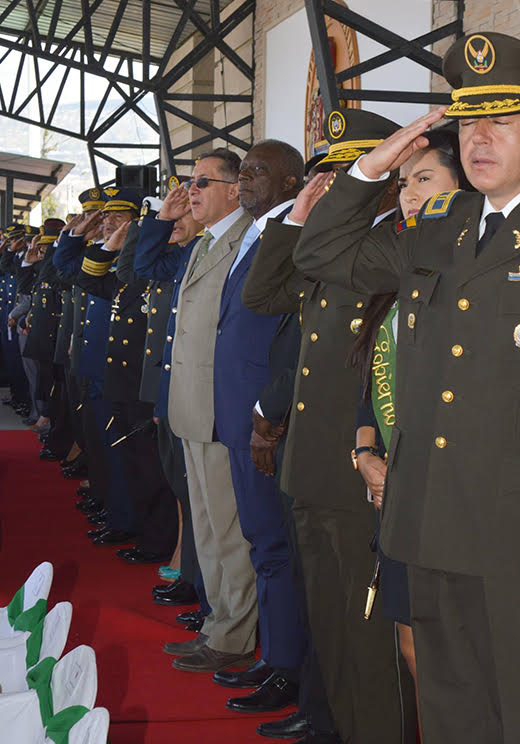
To this effect, Ecuador pledges its support for the training of instructors who will be responsible for training the soldiers there, that is to say in Haiti. Likewise, specialization programs will be offered for Haitian officers who will integrate the military medical corps, the military engineering corps, the military agronomy corps and other fields deemed useful in order to allow the new Defense force to participate fully. national development efforts.
The UN also stresses that the vegetation cover is very low in Haiti, even if the lack of updated data does not allow to determine with exactitude the rate. One of the factors that contribute to deforestation is the cutting of trees for the production of charcoal, which in 2012 was used in 92% of Haitian households for cooking. According to the FAO, 10,000 bags of charcoal are consumed per day in the country.
In addition, soil erosion greatly increases the vulnerability of populations to natural disasters, particularly cyclones, bad weather and earthquakes.
Once again, United Nations studies warn that the poorest women and households are disproportionately affected by environmental degradation, especially rural households with a woman as head of household, since ‘they primarily suffer from the drop in agricultural yields caused by the consequences of deforestation. . In response, the United Nations is encouraging national efforts to produce more with less increasing efficiency, the conservation of natural resources and the restoration of degraded lands through better agroforestry, environmental and agroecological practices, as well as the conservation of local varieties. . These practices would allow the reduction of post-harvest losses of agricultural products (currently around 30-40%, according to the Ministry of Agriculture MARNDR).
Despite the gravity of the situation, the Haitian Government, supported by its partners, has taken actions to slow down the degradation of the environment and mitigate the resulting risks, such as:
• The signing of United Nations conventions such as the Biological Corridor in the Caribbean (CBC), the United Nations Convention to Combat Desertification (UNCCD) and the United Nations Framework Convention on Climate Change (CCNUC)
• The creation of new protected areas including the first marine areas in the South and in the North
• The delimitation of the National Parks of Macaya, La Visite and the Pine Forest
• The creation of the La Selle Biosphere Reserve
• The establishment of Protected Areas management structures such as the National Agency for Protected Areas (ANAP) and the deployment of the Surveillance Corps in Protected Areas.
Philippe Brunet