
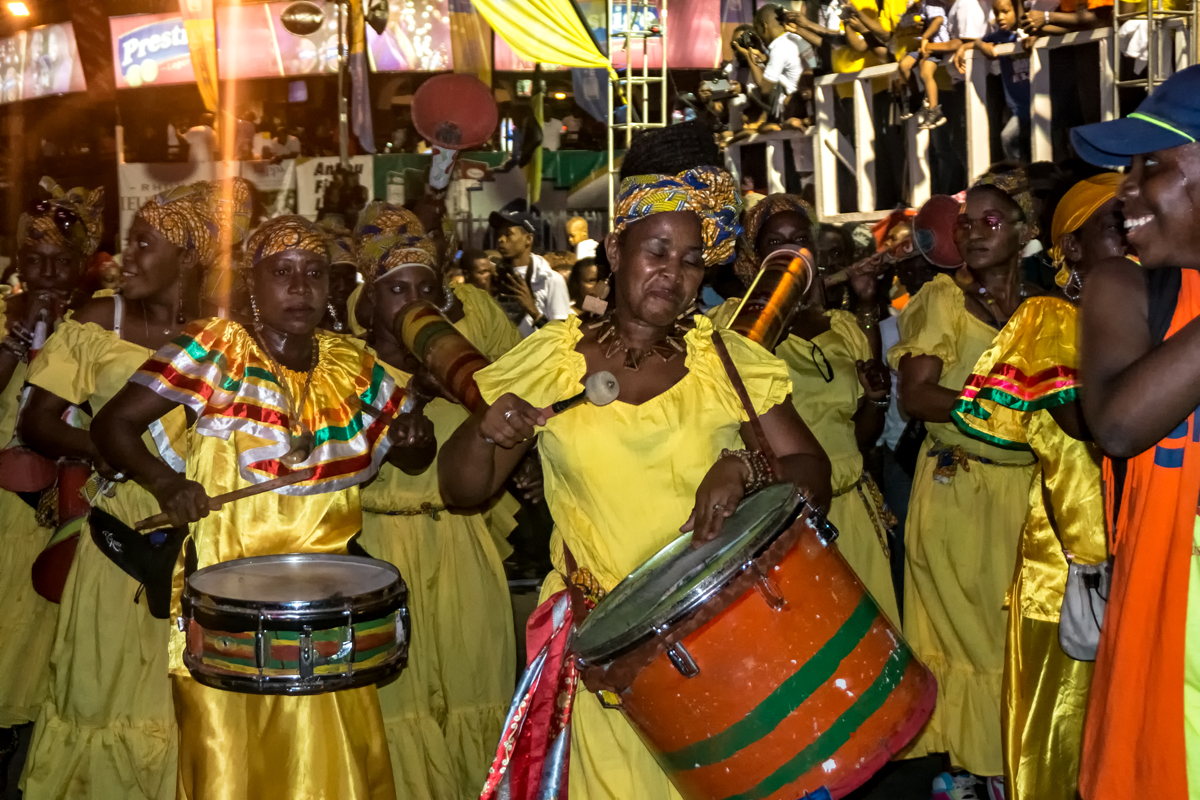
Painting, sculpture, literature, music, Creole language …
It was after the independence of Haiti in 1804 , which put a definitive end to slavery, that we saw the emergence of typically Haitian “works”. These works are first inspired by the voodoo religion, because the drums are beaten during ceremonies, the walls of the temples are decorated with representations of saints (confused with the spirits or “loa”) and on the ground of the temples are traced the ” vèvès ”, geometric symbols personifying these same spirits, and which would be taken from the drawings of the Arawaks, the first inhabitants of the island. However, voodoo has been censored and persecuted for more than two centuries, both by the first heads of state and by the Catholic and Protestant churches; It is only since the 1980s that it has been accepted as a religion, like any other, and that artists can openly draw inspiration from it.
Through this section, we have therefore tried to draw up a panorama as complete and representative as possible of Haitian culture and arts, concerning:
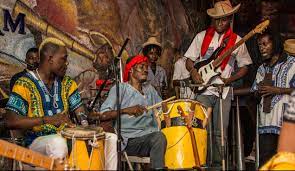
Haitian music
Music is an important part of Haitian life. The forms of musical cadences are varied. Kompa, messenger music, Twoubadou, zouk and root rhythm form the basic quartet of the culture specific to the island.
This music is undergoing changes to harmoniously combine with rhythms of rumba, jazz or rock.
Alongside these forms, the musicians are influenced by the rhythms of neighboring countries: merengue, but also hip-hop, ragga or reggae. While some musicians stay on the island, others export their art to the world, such as Ti Jack.
Haitian literature
“Haitian literature is the most venerable and has long been the richest of ultramarine literatures in the French language” (Léon-François Hoffman). Although the Haitian population is of Creole language and that the French language, “spoils” of the war of independence, is spoken only by a minority of Haitians, the Haitian writers of French language are numerous, and more and more famous, as shown by the many literary prizes they have won in recent years. As with painters, it is not possible to name them all!
As early as 1804, the first wrote books on the history of their country: Pierre Flignaud, Pompée Valentin, Juste Chanlatte, Beaubrun Ardouin. Then throughout the 19th and 20th centuries, plays, poetry, essays and novels emerged: Julien Lhérisson made himself famous with his novel “La famille des Pitite-Caille”, Jean Price-Mars with his poems , Jacques Roumain by his novels, the most famous of which is “The governors of the dew”, Jacques-Stéphen Alexis by his fictionalized quadrilogy “Compère Général Soleil, Les Trees Musicians, L’Espace d’un cillant, Romancero aux étoiles”, but whose promising career was interrupted by Duvalier’s bullets; René Depestre, known for his first novel “Hadriana in all my dreams”, but who lives in exile in France; Frankétienne, the demiurge of language, which mixes Creole and French in its language “spiral”; Jean Métellus, doctor and poet; Anthony Phelps the poet; Lionnel Trouillot, novelist and playwright; Gary Victor, the cantor of the secret voodoo societies; Dany Laferrière, who lives in Canada and who won the Medici Prize last year for his novel-poem “The Enigma of the Return”.
Without forgetting the tradition of tales, and the Haitian storyteller famous in France, Mimi Barthélemy.
Haitian literature in a dynamic of emancipation
The country of Haiti is the fruit of multiple origins: first, a country of Indian tribes, among which the Taïnos, then monopolized by Spanish settlers, then French, Haiti has gradually built itself into a nation, thanks in particular to , in the liberation struggle of its population of African origin, mainly slaves and freed.
Haiti is therefore a young nation which has recently imposed itself on the world political scene thanks to its act of independence of 1804. And the history of Haitian literature is closely linked to the convulsions of a search for identity, for a search for roots, undertaken by the whole of society in order to establish national sovereignty.
Progressive taking into account of “popular values”
The starting values, embodied by “the elites” are naturally those which the modern western world: instruction in the dominant (Catholic) languages and religion; quest for comfort through employment, enrichment; control of health and safety through increasing industrialization to the detriment of rural values.
However, very early on, the Haitian leaders and especially the intellectuals, from Boirond-Tonnerre, to the Nau and Ardouin brothers via Tertulien Guilbaud to Beauvais Lespinasse, who perfectly mastered the French language, became aware of the gap that separated them from more and more of their fellow citizens, mainly of rural origin. The difficulties of governance and the strength of racial and / or class prejudices prevented this population from having access to the progress of the modern world that leaders always promised.
From that moment on, writers knew that the conquest of the dignity of the Haitian people went through the recovery of their language: Creole and the promotion of customs specific to the rural world (agricultural work, leisure, protections, securities, beliefs, dreams and hopes which are part of peasant customs). However, this dynamic did not exclude tendencies in contempt of the so-called “lower” classes or the power of racialist prejudices.
A literature of “us”
This is how Haitian literature gradually distinguished itself from model literature, French, by the treatment of specific themes such as patriotism and the glorification of the heroes of the wars of independence: Toussaint Louverture, Jean-Jacques Dessalines , King Christophe, Pétion, etc. ; the elaboration of founding myths as in Stella (1859) by Emeric Bergeaud, the first Haitian novel. The theme of “color prejudice” is constant in the plays, poems and novels: “Le Fils du Noir”, “Choucoune” in fact written in Creole, poems by Oswald Durand; and even novels, said to be exotic because the setting is outside Haiti, such as Francesca (1873) by Demesvar Delorme or La Chercheuse (1880) by Louis-Joseph Janvier, or Le Damné (1877) evoke problems of love. in connection with racial prejudices. The quest for the law, for landmarks is inscribed from the first Haitian novel. These moralizing concerns are manifested through the predilection for fables, proverbs, tales inherited from the Creole tradition. This is what will justify the extensive use of the pronoun “we” in many essays and especially novels.
A literature of linguistic mixing
The romantic period between 1836 and 1885 saw the development of the evocation of local color: popular scenes in towns, work in the fields and peasant customs, the theme of voodoo …, even if the writing work often lacks authenticity, remaining too close to the ethnographic perspective, as a certain journalist from L’Union of August 17, 1837 recognizes: “The French language in our writings always seems like an acquired language: one of the benefits of civilization will be to naturalize it with us. This is how the process of linguistic interbreeding begins, even if all writers do not engage in this option, far from it. But the debate is launched. During the periods of La Ronde and La Nouvelle Ronde (1885-1925), the debate raged between the proponents of a writing language faithful to French models, as desired by the great poet Etzer Vilaire (or Georges Sylvain d ‘ elsewhere) who are afraid of seeing the development of “a bastard language which is neither entirely Creole nor especially French”, anxious to write in a language capable of translating universal feelings; and followers of the transformation of the French language or at all Creole: thus saw the light of the novels of Frédéric Marcelin (Marilisse, 1903), Justin Lhérisson (Zoune chez sa Ninaine) or Fernand Hibbert (Séna, 1905), including the structure is inspired by a form of Creole dialogued speech called “audience”. Thanks to this loan, the novel gains in comic strength and vitality. During this period (1884-1889), great debates on social questions and national sovereignty, on the problems of agriculture and education are carried by essayists of great name like Louis-Joseph Janvier, Anténor Firmin and Hannibal Price, who are also known to have developed an anti-racist argument; these debates are relayed by renowned periodicals between 1895 and 1912: La Ronde, La Jeune Haiti, Literary and Social Haiti, Literary and Scientific Haiti …
Then, the period of Indigenism, followed by that of the griots (1925-1975) will be fruitful in linguistic and literary inventions.
Bruised by the American occupation (1915-1935), many Haitian intellectuals engaged in resistance, at least moral, through works of a patriotic tone, likely to awaken the national conscience. Thus spoke the uncle (1928) of Jean Price-Mars es t a scientific and didactic essay (ethnographic, sociological, anthropological …) which marked the time, because it reconciles all the components of Haitian reality, including the most contradictory, and promotes for each Haitian a better acceptance of his “self” “. Jean Price-Mars made his contribution to the culture of “crossbreeding”. Through a rational and scientific approach, he tried to eradicate the shame inherent in the negative perception that we had of rural and African universes at the time. This period saw the founding of the first Haitian Communist Party (1934) and the creation of the Bureau of Ethnology (1941) by the poet Jacques Roumain. A Haitian philologist, Jules Faine, published the results of his research: Creole Philology (1936), Le Créole dans l’univers (1939). We should also note the influence of the Surrealist and Négritude movements: André Breton and Aimé Césaire came to Haiti to encourage writers who received them favorably. These movements inspired typically Haitian literary trends, such as the “marvelous realism” initiated by J.-S. Alexis or the “spiralism” initiated by René Philoctète, Jean-Claude Fignolé and Frankétienne.
Many writers opt for a French language increasingly shaped by the breath, rhythm and images of Creole orality. The writer’s identification with his popular fictional hero is better perceptible: a more emotional text which can sometimes lead to good successes: Gouverneurs de la rosée (1944) by Jacques Roumain, The Seeds of Wrath (1949) by Anthony Lespès, Pariahs of Magloire Saint-Aude, many novels by Jacques-Stéphen Alexis. Even if certain writers, like Léon Laleau, then later the poet Bonnard Posy, Alix Mathon, or Jean Brierre plead for a classic treatment of French, according to the rules of the old metropolis, many among them, like Emile Roumer, Félix Morisseau -Leroy (Diacoute in Creole) or Franck Fouché will campaign for the production of works in Creole and bilingual.
A literature torn between the desire to satisfy the local reader and that of satisfying the foreign reader In Haiti, writers have always felt frustrated at not being able to be truly appreciated by the majority of their compatriots who could not read French any more than they did Creole. Strictly speaking, no publishing houses, certainly printing houses, but self-publishing is ruinous. All this context encourages the writer to be published abroad, with the constraints, the concessions that this implies, because the French, Quebec, Swiss or Belgian publishing house seeks profit by trying to satisfy as many people as possible. French-speaking readers. It must be recognized that this edition abroad is stimulating for the writer, delighted to increase his audience internationally, but in a way also among his compatriots; the author is also encouraged to produce more and more.
The dictatorship of François Duvalier from the years 1965, even if it did not really dry up the inspiration of the writers, it reduced to nothing their freedom of expression. This is how many of them went partially or totally into exile either in Canada (possibly in the United States), in France, or in Belgium. Thus they were able to have themselves edited more easily: Amour, Colère et Folie (1968) by Marie Vieux-Chauvet, Less Infinity (1972) and Mémoire en Colin-Maillard (1976) by Anthony Phelps, Le Huitième jour ( 1973) by René Philoctète, Les Chiens (1961) by Francis-Joachim Roy, Compère général Soleil (1955) and L’Espace d’un cillation (1959) by Jacques-Stéphen Alexis. The writings of the poet René Depestre also enjoyed great promotion from his exile. Roger Dorsinville’s works were published from his expatriation. This is also the case with Jean Métellus, almost all of whose novels have been published by Gallimard. Lately, publishing houses have become more offensive and more willingly publish writers living in their country of origin: Frankétienne, Gary Victor, Lyonel Trouillot, Yanick Lahens, etc.
Exile and expatriation contribute to modifying the data of Haitian literary creation which tends to diversify more and more. From 1980 dominates a freedom of creation. Haitian writers, according to their relationship to Creole, according to the places where they have chosen to live, according to their relationship to their social environment or to the homeland, individualize their career as creators, giving rise to increasingly varied styles.
The number of French-speaking Haitian authors is constantly increasing as well as, without commonality however, the number of Haitian Creole-speaking authors who, for bilingual publications, try to associate with Creolophones from other geographical locations (Martinique, Guadeloupe). , The meeting).
Anne Marty Doctor of Letters
Author of:
• The Female Character in Haitian and Quebec Novels from 1938 to 1980: Treatment and Meaning, A.N.R.T. (Thesis à la carte), Presse du Septentrion, Villeneuve d´Ascq (59), 1997
• Haiti in Literature, La Flèche du temps / Maisonneuve and Larose (Servédit), Paris, 2000
Painting and sculpture in Haiti
Painting
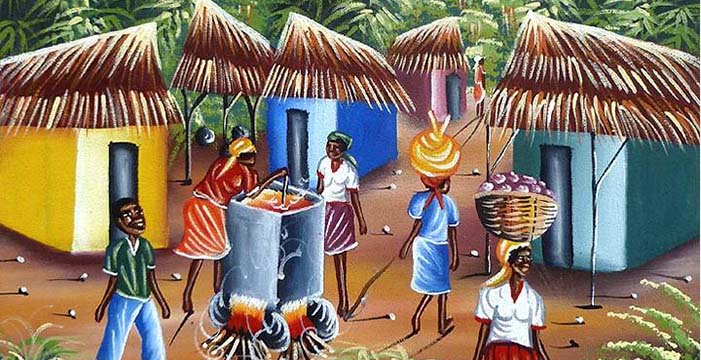
Haitian painting is characterized both by its sources of inspiration, popular and spiritual, and by an original style embodied by naive artists.
The early days
Painting has always been a traditional form of expression in Haiti as evidenced by wall decorations and religiously inspired illustrations, some dating back to the 18th century. While wealthy settler families imported paintings from Europe or brought in Western painters there, others sent their free slaves to France to learn painting and exploit their talent. This is particularly the case of Léogâne’s portrait painter, Luc.
The first Haitian Academy of Painting was created in Cap-Haitien by King Christophe shortly after independence (1804). In 1816, Pétion opened an art school in Port-au-Prince where French painters came to teach. Between 1830 and 1860, historical subjects linked to slavery, and religious subjects, particularly around the voodoo cult, then constituted the main themes of the artists, whose production was still masked by the activity of copyists.
The naive Haitians
After World War II, the American painter and teacher Dewitt Peters founded an art and painting school in Port-au-Prince in 1944. His teaching remains initially academic and influenced by Western or American currents. Impressed by the naive style of street painters, Peters decided to welcome, in addition to his traditional students, self-taught people to whom he provided the material which would enable them to express their talent. A first wave of these artists began to gain a certain notoriety, such as Hector Hyppolite, Rigaud Benoit, Castera Bazile, Wilson Bigaud or Robert Saint-Brice. This is the start of the “naive Haitian” movement.
During his travels in Haiti, in 1943 and again in 1945, the French poet André Breton admired these works, which he associated with his surrealist approach. He then published a text devoted to Hector Hyppolite, which attracted
the attention of French intellectuals to Haitian painting. Other writers, such as Jean-Paul Sartre in 1949, visited the island around the same time.
In the 1950s, Haitian painting evolved and diversified, opening up to different forms of expression, but always favoring colors and line. Several workshops are emerging in different parts of the territory. Naive Haitian art then spread throughout the world: the Museum of Modern Art in New York purchased canvases by the most fashionable artists while Time Magazine reproduced Haitian frescoes in its editions.
The term “naive” then describes a figurative style dominated by solid colors and popular subjects (street scenes, bustling markets, animal fights, etc.). It is less applicable to the technique of artists who are totally in control of their art. In the 1960s, buyers snatched up the works of naive Haitians, which became sought-after items in the art market. This brutal commercial interest, which provoked the emergence of a genuine artisanal industry of naive paintings, would bring artists like the community of Saint Soleil to go back to their roots by placing voodoo culture at the heart of their approach.
Voodoo painting
The voodoo cult appears very early in Haitian painting. The two most striking and symbolic figures are Hector Hyppolite and Robert Saint-Brice, whose artistic approach has been praised by André Breton for the first, and by André Malraux for the second.
In the early 1970s, Maud Robart and Jean-Claude Garoute (known as a painter as Tiga) created an art center intended to welcome artists around the theme of the voodoo mystery. They first settled him in the Nénettes neighborhood, in Pétionville, on the outskirts of Port-au-Prince. The experiment is inconclusive, but the two intellectuals cling to their project. They moved in 1973 to Soisson-la-Montagne, about fifty kilometers from Port-au-Prince, on the heights of Pétionville. They meet on site masons, cooks, gardeners and peasants to whom they lend a room, brushes and canvases. The painting of these “residents” will be oriented towards the theme of voodoo. Their group will be considered as a school, called “Saint Soleil”. In 1975, Malraux visited this community and gave it a mystical aura in his essay L’Intemporel1: it prolongs and amplifies, nte years after André Breton, the attraction and seduction that Haitian painting exerts: “An artist’s people lives in Haiti” he writes, stressing that on the island, everything is subject to pictorial transcription: the market, marriage, fishing and religion, syncretic as in Cuba and Brazil.
In 1978, the Saint Soleil community broke up but the most involved and talented painters wanted to continue painting: Louisiane Saint Fleurant, Denis Smith, Dieuseul Paul, Levoy Exil and Prospère Pierre Louis, the “Saint Soleil histories” created a informal group which takes the name of the “Five Suns”. These artists will spread and many painters will recognize themselves in their approach: thus artists like Payas or
Stevenson Magloire (Louisiana’s son Saint Fleurant, who died assassinated) became known throughout Europe and the United States.
For a long time, canvases by these artists have been found in the most unlikely stores, including tourist shops, in which they rubbed shoulders with naive painting. Today, a market has been organized around voodoo painting, and the paintings of its representatives are sold, often very expensive, in American and French galleries.
Among the thousands of Haitian painters, we can cite the most famous: first of all women painters, minority: Luce Turnier, Tamara Baussan, Michèle Manuel; then the authors of the frescoes adorning the Sainte-Trinité church (collapsed during the earthquake of 12.01.10): Hector Hyppolilte, Wilson Bigaud, Préfète Duffaut, Castéra Bazile; the painter of the “voodoo pantheon”: André Pierre; a brilliant portrait painter: Mario Benjamin; the “master of masks” Tiga and, with him, the painters of the “Saint-Soleil” school he created: Prosper Pierre-Louis, Richard Antilhomme, Saint-Jean Saint-Juste, Louisianne Saint-Fleurant, Levoy Exiles who painted, they said “inspired by the loa”; and finally, last but not least, Barbara Prézeau, painter and visual artist who created the Africa-America Foundation, to bring art from the two continents …
The sculpture
Many works describe Haitian painting, but sculpture – on wood, roots, stone, clay, metal … – is less well served, except “the bogus sculpture” or “cut irons” which has been the subject of several books; this art / craft is strongly inspired by Greek and voodoo mythologies and is illustrated by Serge Jolimeau and his successors.
This article examines the historical, social and material conditions of voodoo practices in Paris and Ile-de-France. The challenges of these practices underline a dynamic of visibility and invisibility, inclusion and closure which determines both human relations within worship and relations with a French society resistant to voodoo. Its presence in Paris dates back to the 1960s, with staging inspired by the cult, and it is part of a history that begins with the tours of folk troupes, formed in Port-au-Prince in the 1940s. Contemporary practices vodou in Ile-de-France require material and ritual adaptations. They stem as much from a logic of protection as from power relations based on religious authority and on the ethnic origin of the practitioners. Voodoo turns out to be a space of competition where legitimation processes, conveyed by rumors, are based on traditions and territories, on the economic dimension and on respect for ritual prescriptions. The circulation of these rumors, from Paris to Brooklyn, suggests the existence of a transnational space of morality based on social and religious norms that originate in Haiti.
Haitian proverbs
Here is a small selection of Haitian proverbs from our friend Talégrand Noël who reveals them to us by giving us some keys to understand them. Talégrand is Haitian of rural origin, artist, novelist and great connoisseur of many proverbs (see our bibliography) In Haiti, proverbs are part of popular culture, they are in the thousands and are transmitted orally from generation to generation thus constituting a rich heritage. The peasants handle these proverbs with perspicacity and a lot of repartee, thus avoiding them to launch into great speeches while being made well understood.
Haitian hospitality
• “Kay piti nat anba bwa”: The house is small, we take our mats under our arms (Even if we are a little tight, we must make room to welcome and accommodate everyone)
• “Manje kwit pa gen mèt”: Cooked food has no master (You have to share with anyone who arrives at mealtime)
• “Sa pòv genyen se li l pote nan mache”: What the poor have is what they bring to the market (You have to offer or know how to be content with what you have)
• “Bay piti pa chich”: Giving little does not mean that you are stingy (You give what you have.
Understood: if we had a lot, we would give more)
• “Se anvi bay ki bay”: It is because we really want that we have given (Make a gesture of generosity when we ourselves are in a precarious situation)
Wisdom
• “Konn li pa di lespri pou sa”: Knowing how to read does not mean that you have wit (being literate does not mean that you are intelligent)
• “Konesans get rich”: Knowledge is wealth
• “Bwa pi wo di li wè lwen, men grenn pwomennen di li wè pi lwen pase l”: The tallest tree says it sees far, but the seed that walks says it sees further than it (The one who travels is more likely to discover things that the one who never travels will not see)
• “Rayi chen, men pa di l fimen tabak”: We can hate the dog, but we must not say that he smokes (You must not accuse someone of what he is not capable of)
• “Pa janm koupe dwèt moun k ap ba or manje”: Never cut the finger of whoever gives you food (Do not be ungrateful or mean to someone who helps you)
• “Lè bab kanmarad or pran dife, mete pa or alatranp”: When your friend’s beard catches fire, you can start to soak yours (You should not rejoice when misfortune strikes at the neighbor. , no one is ever completely safe)
• “Bat chen an tann mèt li”: Beat the dog, wait for his master (When hurting someone who is unable to defend themselves, expect retaliation from those close to them)
• “Twò prese pa fè jou louvri”: Being in too much of a hurry does not make you get up in the morning (there is no point in rushing)
The family, the children
• “San se san, dlo se dlo”: Blood is blood, water is water (Whatever the circumstances, we always remain sensitive to the situation of someone with whom we have blood ties)
• “Pitit se richès malere”: Children are the wealth of the poor
• “Pitit se baton vyeyès”: Children are the stick of old age (Children are the life insurance of the elderly)
• “Tanbou bat nan raje, men se lakay li vin danse”: The drum or the music is played in the woods, but the dance is performed at home (The acts that one commits outside the home have any how it affects the rest of the family or will be known to the family)
• “Koulèv ki gen ke pa janbe dife”: A snake with a tail does not cross the fire (You have to be careful or you should not take unnecessary risks when you have family and / or responsibilities)
• “Manman chen pa janm mòde pitit li jous nan zo”: A bitch never bites her young to the bones (You cannot hurt your own child or your own flesh)
• “Tete pa janm twò lou pou mèt li”: The breasts are never too heavy for the people who have them (Even if it is difficult, one always strives to assume one’s responsibilities when it comes to one’s breasts. own property or offspring)
• “Dwèt or santi or pa ka koupe l jete”: Even if your fingers stink, you cannot cut them to throw them (Whether someone does things that are harmful to members of his family, we cannot rid or kill him for as much)
Life lessons
• “Jan cat mache lajounen se pa konsa li peche lannwit”: The way the cat walks during the day is different from the way he hunts at night (do not be fooled by appearance)
• “Se lè kay pran dife or konn konbyen kokobe ki te ladan”: It is when a house burns down that we know how many handicapped people there were inside (When an affair comes to light, we are often surprised by the identity of the protagonists)
• “Se rat kay k ap manje kay”: It is the house rat who eats it (No need to look elsewhere, the culprit is in the close circle (family or friends))
• “Rat manje kann, zandolit mouri inosan”: Rats eat sugar cane, anoles (a species of lizard) die innocent (The innocent pay for the guilty)
• “Twou manti pa fon”: The hole of lies is not deep (The truth always comes to light in the end)
• “Moun ki ba ou konsèy buys kabrit nan lapli, se pa li ki ede w pran swen li nan lesèk”: Those or those who advise you to buy goats during the rain are not those who help you to feed them when the drought comes (Advisors are not payers)
• “Chay sot sou tèt tonbe sou zèpòl”: The burden comes out of the head to land on the shoulders (In voodoo language, to say that someone is or will be spared (healed) to the detriment of a member of his own. family that will perish in its place)
• “Dan pouri se sou fig mi li gen fòs”: Rotten teeth exert their force against ripe bananas (Cowards always prey on the weakest)
• “Sa w fè se li ou wè”: What you do is what you see (You harvest your what you sowed)
• “Jan chache, jan twouve”: The way we search is the way we find (You looked for it! Or you deserved it!)
Words of hope, of struggles
• “Jistis Bondye se kabwèt bèf”: The justice of God is a cart pulled by an ox (Divine justice is like a cart, slow but efficient. It is understood that it will happen sooner or later)
• “Toutan tèt poko koupe, li espere pote chapo”: As long as her head is not cut off, she hopes to wear the hat (As long as you are alive, you have to fight without ever despairing)


2 comments on “Painting, sculpture, literature, music, Creole language …”
horse gelatin trick
baking soda horse trick recipe
horse soda trick
baking soda horse trick recipe